Overview
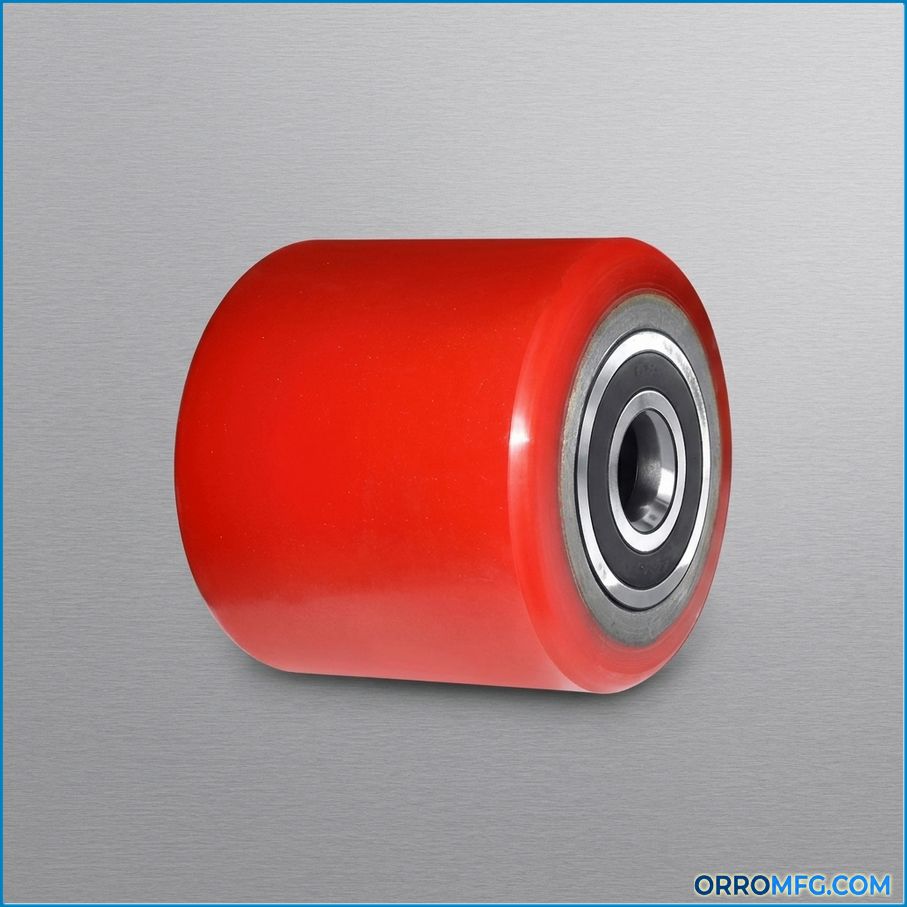
A PU caster wheel is a polyurethane tread bonded to a rigid core and mounted in a steel bracket, so a trolley, cabinet or machine base rolls quietly without marking the floor. Polyurethane sits between rubber and nylon: it is soft enough to absorb vibration and protect tiles, epoxy and timber floors, but hard enough to carry industrial loads without flat-spotting under a parked trolley. It also resists oils, greases and most mild chemicals, which is why it is the default wheel on workshop, warehouse, medical and food-service equipment.
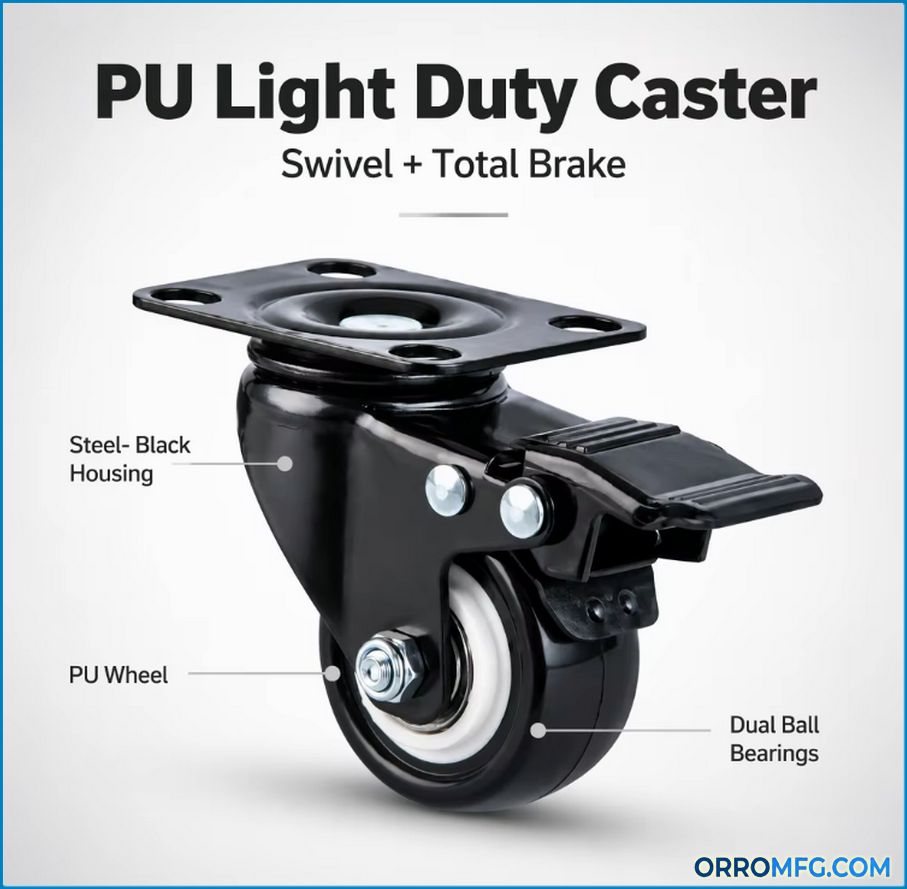
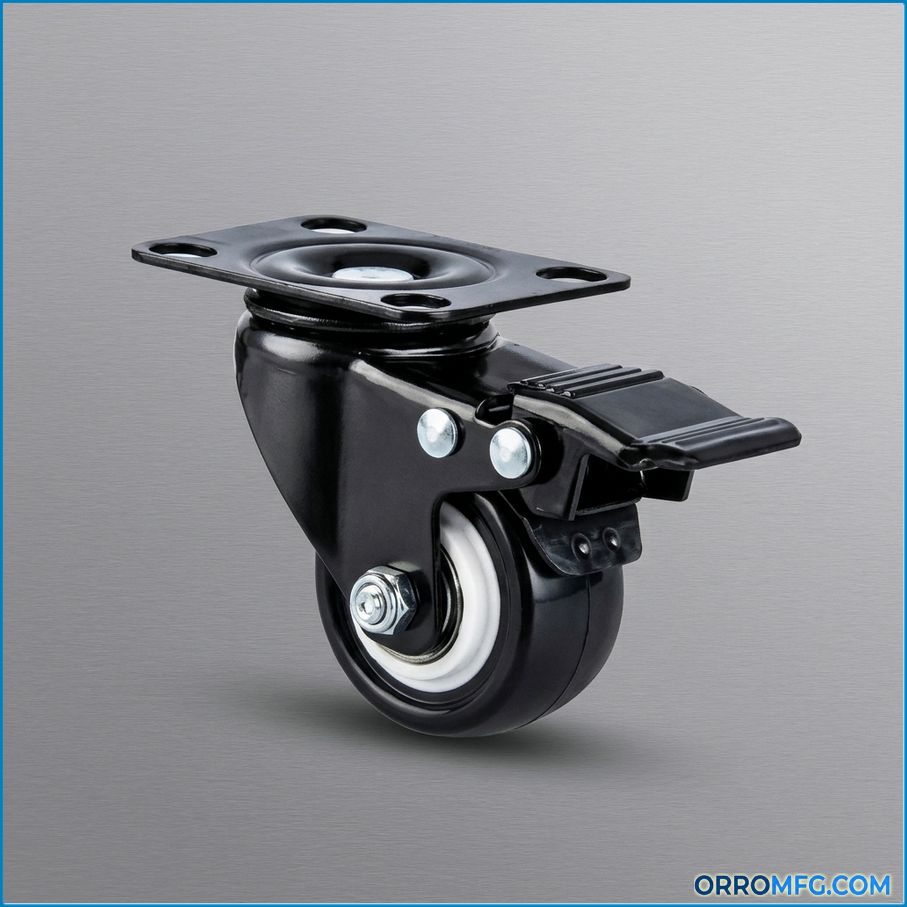
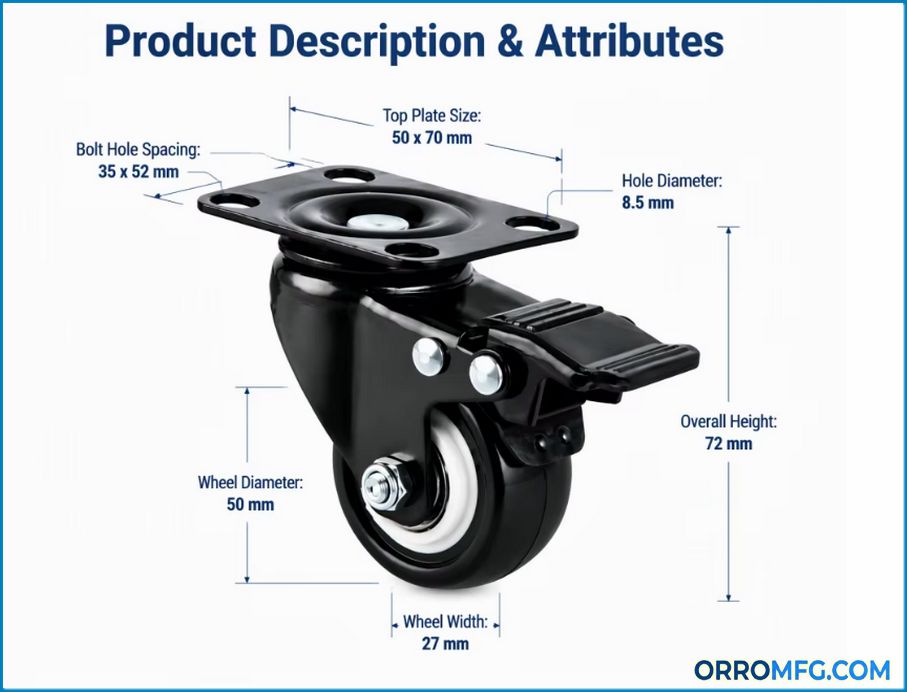
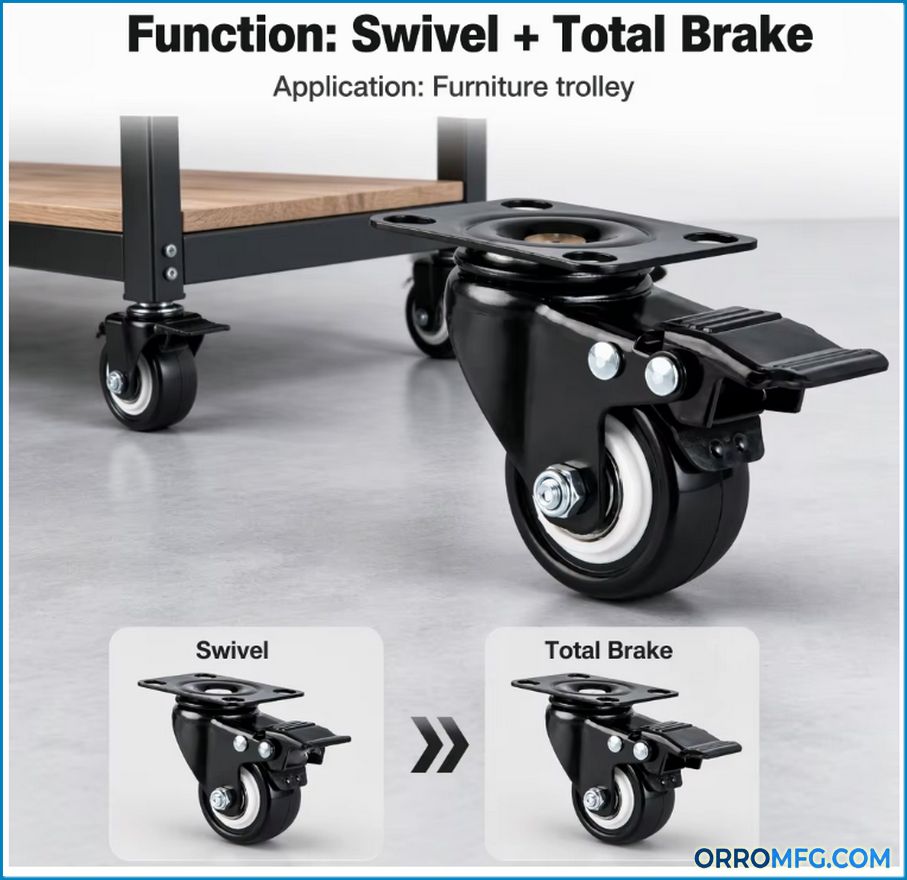
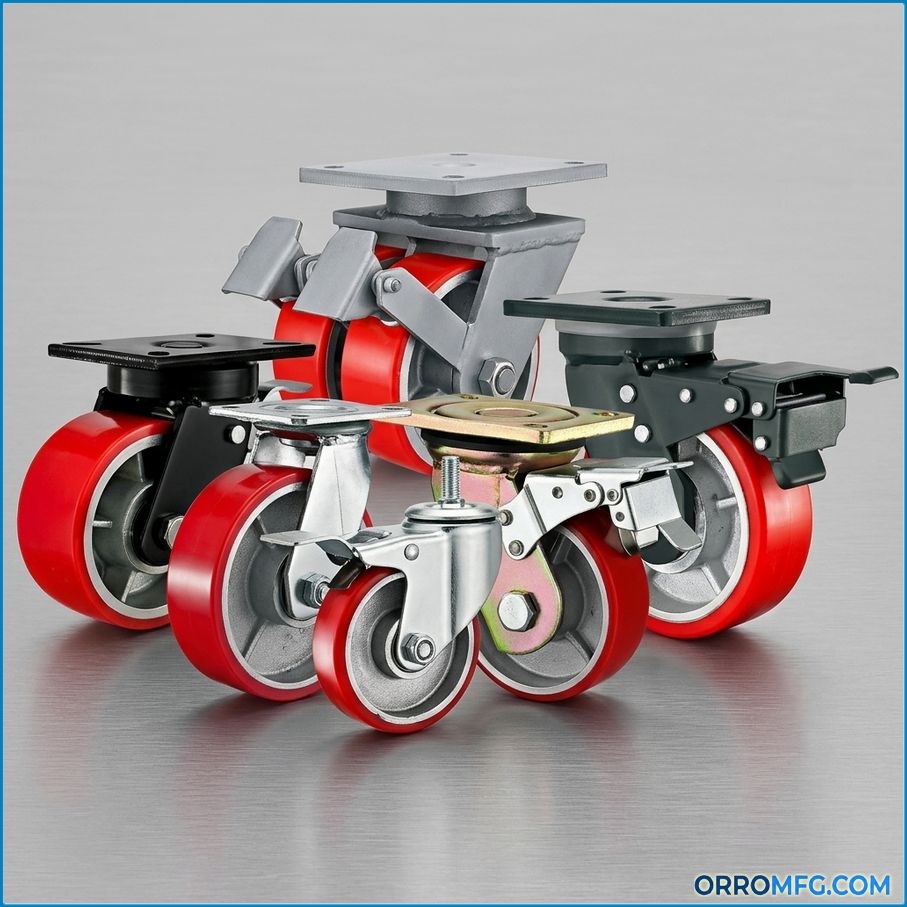
Our range covers the two ends of the market. Light-duty plate casters — the 50 mm swivel with total brake shown here — are used on furniture trolleys, display stands, tool cabinets and light carts, and run from 1" to 3". Heavy-duty casters use the same PU tread on a cast iron core in diameters from 50 mm to 300 mm (2"–12") for pallet trucks, AGVs and machine bases. Both are supplied as swivel, fixed or braked versions, with the bracket, plate and bearing matched to the load.
Why PU Instead of Rubber, Nylon or Cast Iron
| Wheel material | Floor protection | Noise | Load capacity | Rolling effort | Best for |
|---|---|---|---|---|---|
| PU (polyurethane) | Good — non-marking | Low | Medium to high | Low | Mixed floors, trolleys, cabinets, general handling |
| Rubber | Excellent | Very low | Low to medium | Medium-high | Rough or uneven floors, outdoor use |
| Nylon | Fair — can mark | Medium | High | Very low | Smooth concrete, high loads, hard floors |
| Cast iron | Poor | High | Very high | Low | Heavy machinery, hot or oily environments |
| TPR / thermoplastic rubber | Excellent | Lowest | Low | Medium | Hospitals, shops, quiet indoor use |
PU gives the best balance for most industrial trolleys: low rolling resistance means less push force and less operator fatigue, the tread does not leave black marks on light floors, and it will not flatten when a loaded cart stands in one place for weeks. Choose rubber where the floor is cracked or has thresholds, nylon where the floor is smooth and the load is high, and cast iron where heat, oil or impact rules out any polymer tread.
Light-Duty Series: Sizes and Dimensions
The 50 mm (2") swivel caster with total brake is the standard light-duty unit: black PU tread, black powder-coated steel housing, dual ball bearings in the swivel and the wheel, and a top plate that bolts straight onto a wooden or steel trolley deck. The series covers 1", 1.25", 1.5", 2", 2.5" and 3" wheels, each available as swivel, fixed or braked; the two sizes most often ordered for furniture and display trolleys are tabulated below.
| Model | Wheel diameter | Tread width | Overall height | Top plate | Bolt hole spacing | Hole diameter |
|---|---|---|---|---|---|---|
| 1.5" light duty | 38 mm | 22 mm | 61 mm | 43 × 60 mm | 30 × 42 mm | 6.5 mm |
| 2.0" light duty | 50 mm | 27 mm | 72 mm | 50 × 70 mm | 35 × 52 mm | 8.5 mm |
Load rating is confirmed per size and floor condition; ask for the datasheet for the size you need. The overall height is the dimension that matters when you are replacing casters on an existing trolley — if the new caster is taller, the trolley will lean and one wheel will carry the load.
Swivel, Fixed and Brake Options
- Swivel — the fork rotates 360° around a double-ball raceway, so the trolley steers. Most trolleys use two swivel casters at the steering end and two fixed at the other.
- Fixed (rigid) — no rotation; keeps the trolley tracking straight and carries load in the direction of travel.
- Wheel brake — a cam presses a pad onto the tread, stopping the wheel from rolling but leaving it free to swivel.
- Total lock (total brake) — one pedal locks the wheel and the swivel together. This is the right choice for a cart that must stay put on a slope, in a lift or on a loading dock, because a wheel-only brake still lets the trolley spin around its own axis.
- Directional lock — locks the swivel only, so the trolley can be pushed straight but not turn; used on long runs and in narrow aisles.
The brake pedal is operated by foot, latches in both the locked and released position, and is spring-loaded so the brake releases if the pedal is struck.
Bearings and Mounting
- Dual ball bearing — two rows of balls in the wheel hub, the standard for light and medium duty. Low rolling resistance and long life on smooth floors.
- Single ball bearing — adequate for light loads and intermittent use.
- Roller bearing — for heavier loads and higher speeds where a ball bearing would brinell.
- Plain bore — a simple bushing, used where the caster runs at walking pace and cost matters.
Mounting options are a top plate (bolted through four holes, the most common), a threaded stem (screwed into a socket or a tapped insert), a bolt-hole stem (a single bolt through the frame), or a solid stem for equipment with an existing socket. Plate size, hole spacing and overall height are matched to your trolley so a replacement set fits without redrilling.
Medium and Heavy Duty Range
Above the light-duty sizes the same polyurethane tread is bonded to a cast iron or aluminium core, so it cannot separate under impact or continuous load. Diameters run from 50 mm to 300 mm (2" to 12") and load ratings from a few hundred kilograms to six tonnes per set. All series below are available as rigid, swivel, swivel with brake, threaded stem, and threaded stem with brake.
Note the unit: capacity is quoted for a set of four casters, which is how the load is normally calculated. The right-hand column is the figure for one caster. Wheel diameter alone does not set the rating — a 2" wheel appears in three different series here, and the core and bracket decide which one carries 450 kg and which carries 750 kg.
Medium Duty — 3" to 5", Cast Iron Core
| Wheel diameter | Housing | Capacity (4 pcs) | Capacity per caster |
|---|---|---|---|
| 3" (75 mm) | Zinc plated | 300 kg | 75 kg |
| 4" (100 mm) | Zinc plated | 360 kg | 90 kg |
| 5" (125 mm) | Zinc plated | 450 kg | 113 kg |
Heavy Duty — 2" to 8", Low Centre of Gravity and Standard
| Series | Wheel diameter | Housing | Capacity (4 pcs) | Capacity per caster |
|---|---|---|---|---|
| Low centre of gravity, light | 2" (50 mm) | Painted | 450 kg | 113 kg |
| Low centre of gravity, medium | 2" (50 mm) | Painted | 600 kg | 150 kg |
| Low centre of gravity, heavy | 3" (75 mm) | Painted | 1.5 t | 375 kg |
| Heavy, compact | 2" (50 mm) | Black electrophoresis | 750 kg | 188 kg |
| Heavy, compact | 2.5" (63 mm) | Black electrophoresis | 1.2 t | 300 kg |
| Heavy, compact | 3" (75 mm) | Black electrophoresis | 1.5 t | 375 kg |
| Heavy, large | 4" (100 mm) | Zinc galvanized | 0.9 t | 225 kg |
| Heavy, large | 5" (125 mm) | Zinc galvanized | 1.05 t | 263 kg |
| Heavy, large | 6" (150 mm) | Zinc galvanized | 1.2 t | 300 kg |
| Heavy, large | 8" (200 mm) | Zinc galvanized | 1.35 t | 338 kg |
Super Heavy Duty — 50 mm and 75 mm Tread Width
| Tread width | Wheel diameter | Capacity (4 pcs) | Capacity per caster |
|---|---|---|---|
| 50 mm | 4" (100 mm) | 1.2 t | 300 kg |
| 50 mm | 5" (125 mm) | 1.5 t | 375 kg |
| 50 mm | 6" (150 mm) | 1.8 t | 450 kg |
| 50 mm | 8" (200 mm) | 2.4 t | 600 kg |
| 75 mm | 6" (150 mm) | 3.6 t | 900 kg |
| 75 mm | 8" (200 mm) | 4.5 t | 1,125 kg |
| 75 mm | 10" (250 mm) | 5.4 t | 1,350 kg |
| 75 mm | 12" (300 mm) | 6 t | 1,500 kg |
These ratings assume a flat floor, an evenly loaded frame and normal walking speed. On uneven concrete, through thresholds or where the load shifts, derate by 30-50% — a four-caster trolley often carries most of its weight on two wheels when the floor is not level. The thicker PU tread on the super heavy series absorbs shock, keeps the cast iron core off the floor, and rolls far more easily than a solid iron wheel of the same diameter.
Mounting Dimensions — 4" to 8", 50 mm Tread
Two bracket families cover the 4"–8" (100–200 mm) cast iron core wheels. Both use a 50 mm tread width, but the top plate, bolt-hole spacing and mounting height differ, so a caster from one family will not fit a frame drilled for the other.
Series A — standard bracket, 95 × 110 mm plate
| Size | Wheel diameter | Tread width | Mounting height | Top plate | Bolt-hole spacing | Bearing |
|---|---|---|---|---|---|---|
| 4" | 100 mm | 50 mm | 140 mm | 95 × 110 mm | 85 × 72 mm | 6202 |
| 5" | 125 mm | 50 mm | 160 mm | 95 × 110 mm | 85 × 72 mm | 6202 |
| 6" | 150 mm | 50 mm | 190 mm | 95 × 110 mm | 85 × 72 mm | 6202 |
| 8" | 200 mm | 50 mm | 230 mm | 95 × 110 mm | 85 × 72 mm | 6203 |
Series B — reinforced bracket, 115 × 100 mm plate
| Size | Wheel diameter | Tread width | Mounting height | Top plate | Bolt-hole spacing | Bearing |
|---|---|---|---|---|---|---|
| 4" | 100 mm | 50 mm | 130 mm | 115 × 100 mm | 85 × 70 mm | 6202, double ball |
| 5" | 125 mm | 50 mm | 155 mm | 115 × 100 mm | 85 × 70 mm | 6202, double ball |
| 6" | 150 mm | 50 mm | 180 mm | 115 × 100 mm | 85 × 70 mm | 6202, double ball |
| 8" | 200 mm | 50 mm | 230 mm | 115 × 100 mm | 85 × 70 mm | 6203, double ball |
Mounting height is measured from the floor to the top face of the plate. Quote it together with the plate and hole spacing when ordering a replacement set: a 6" wheel stands 190 mm tall on the standard bracket but 180 mm on the reinforced one, so a mixed set will leave the frame leaning. Mounting holes are slotted on some plates — confirm the hole or slot size against the drawing when the frame uses fixed bolts.
How to Choose the Right Caster
- Calculate the load per wheel. Divide the total loaded weight by the number of casters, then add a safety margin for uneven floors, thresholds and load shift — a factor of 1.5 is a reasonable starting point for a four-wheel trolley. On a three-wheel arrangement the load is not shared evenly, so size for the worst wheel.
- Check the floor. Smooth concrete, epoxy and tile suit PU or nylon. Rough, cracked or outdoor surfaces need a softer rubber tread or a larger wheel to roll over obstructions.
- Check the mounting height, plate and hole spacing as a set. Replacing casters on an existing trolley means matching all three, or the frame will sit unevenly and the bolts will not line up — the same 6" wheel is 190 mm tall on a 95 × 110 mm plate and 180 mm on a 115 × 100 mm plate.
- Decide what the brake must do. If the trolley must not move at all, specify a total lock, not a wheel brake.
- Match the mounting type. Plate, threaded stem or bolt hole, plus the wheel bearing bore that fits the axle.
Applications
- Furniture and display trolleys — light-duty 50 mm casters with total brakes, quiet on timber and tile, non-marking.
- Workshop cabinets, tool chests and workbenches — medium and heavy-duty PU casters that roll over swarf and resist oil.
- Warehouse and logistics equipment — platform carts, shelf trolleys and order-picking carts.
- Medical and laboratory equipment — quiet, non-marking wheels, with stainless or plated housings for washdown areas.
- Food service and retail — display stands, preparation tables and service carts, where a non-marking tread matters.
Customization and OEM Supply
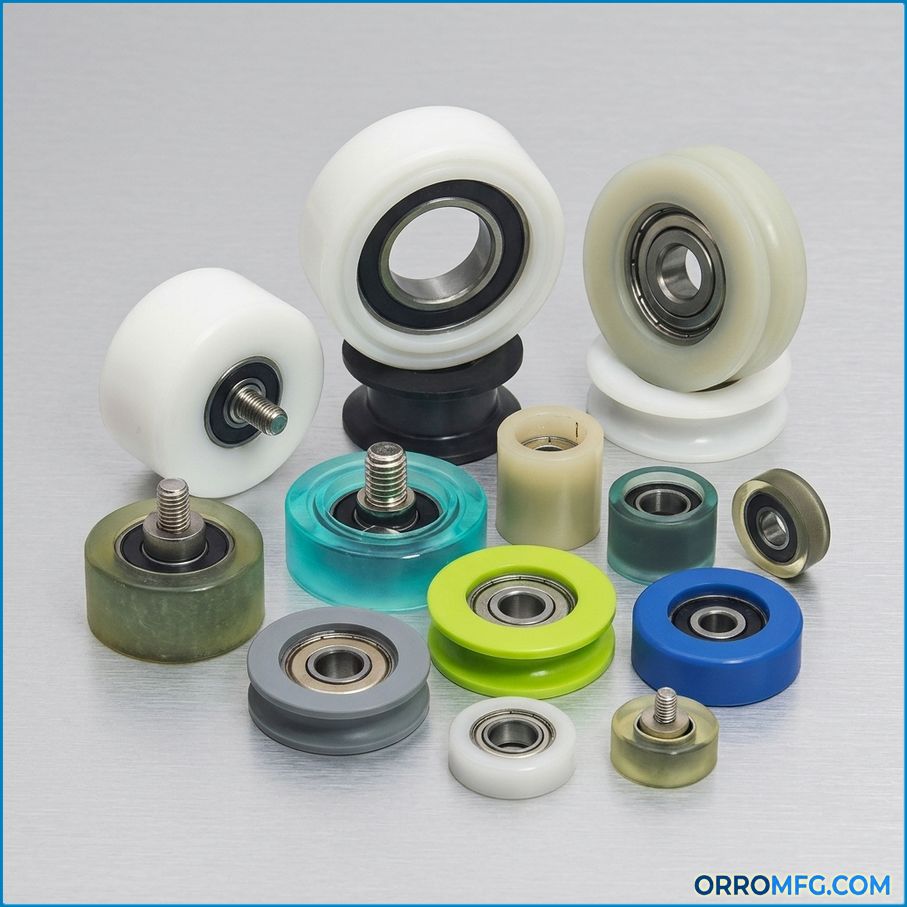
- Wheel size and width — from 38 mm light-duty up to 300 mm heavy-duty, in the tread width that fits the bracket.
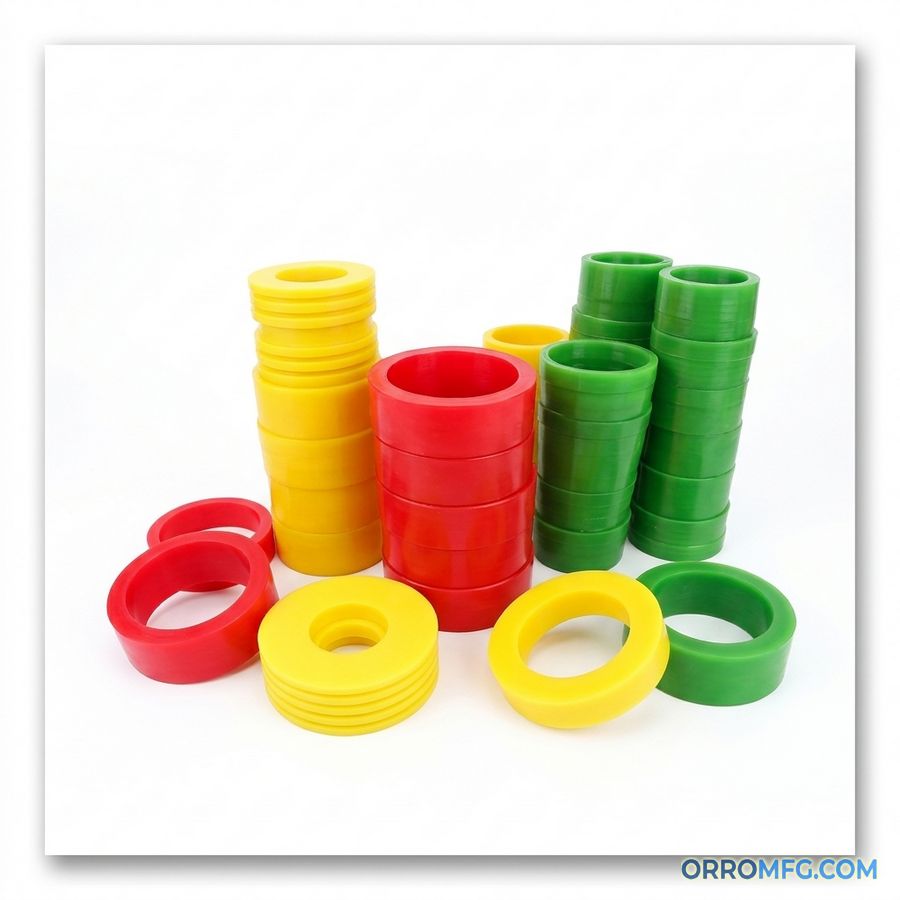
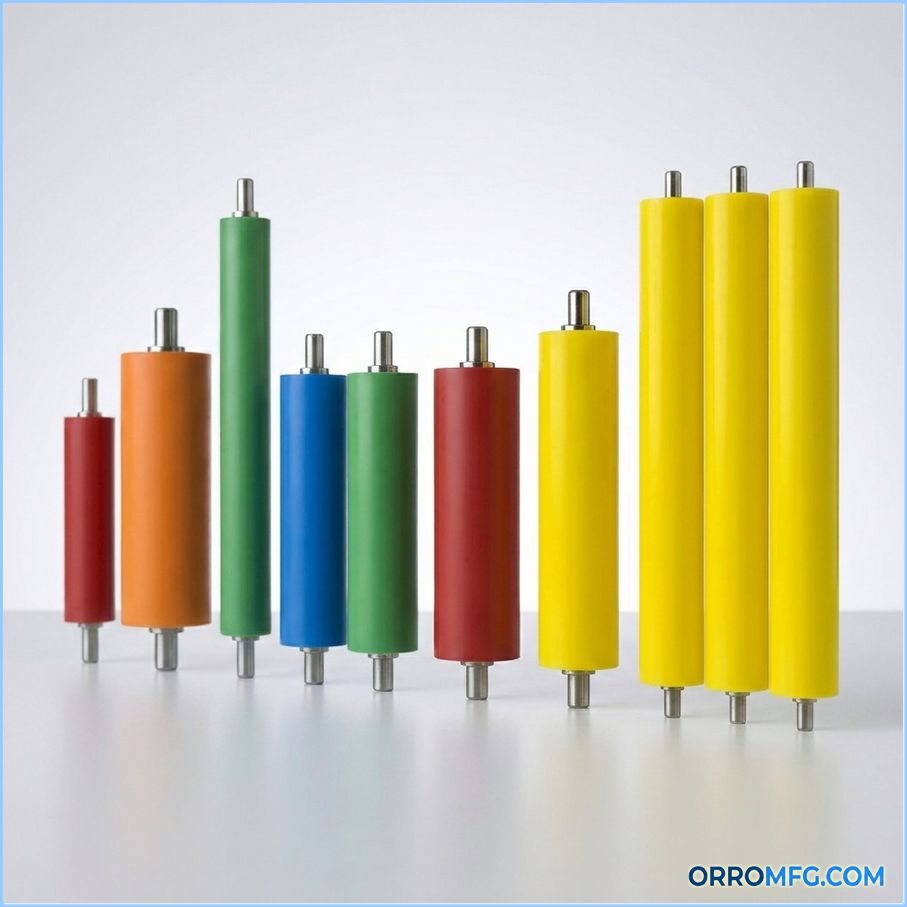
- Colour — black, orange, red, grey and custom colours matched to a sample; colour is often used to distinguish swivel from fixed casters on the line.
- Bracket finish — black powder coat, zinc plating or stainless steel for wet and food environments.
- Bearing and brake — dual ball, roller or plain bore; wheel brake, total lock or directional lock.
- Branding — logo stamped on the bracket or moulded into the tread, plus custom labels and packaging.
- Kits — matched sets of two swivel plus two fixed, packed as one carton for a single trolley build.
Packing and Lead Times
Casters are packed individually in cartons, with sets packed together and labelled by position. Standard sizes usually ship in 7-15 working days; custom colours, brackets and branded versions depend on the tooling or finishing schedule. Samples are available for evaluation before a production order.
Quality Assurance
OrroMFG manufactures PU casters within an ISO 9001:2015 certified quality management system. Tread hardness and bonding are checked on incoming wheels, brackets are inspected for plate flatness, hole position and weld quality, and every assembled caster is checked for swivel freedom and brake function before packing. Batch labels carry the model, wheel size and production date for traceability.
Frequently Asked Questions
What does “total brake” mean on a caster?
A total-lock brake stops the wheel from rolling and locks the swivel, so the trolley cannot roll or spin. A wheel brake only stops the wheel, which still allows the trolley to swivel around that corner.
What is the load capacity of a 50 mm PU caster?
It depends on the series, not the diameter. In this range the 2" wheel is offered from a light-duty unit rated around 113 kg per caster up to a compact heavy-duty unit at 188 kg, and the light-duty series shown above is lower again. Tell us the loaded weight and number of casters and we will confirm the correct series and size.
What is the mounting height of a 6-inch PU caster?
190 mm on the standard 95 × 110 mm bracket and 180 mm on the reinforced 115 × 100 mm bracket. Ask for the height of the exact series you are replacing, and measure the old caster from the floor to the top face of the plate before ordering.
What do the 6202 and 6203 bearing numbers mean?
They are the wheel-hub ball bearing sizes: 6202 is 15 mm bore × 35 mm OD × 11 mm wide, 6203 is 17 mm bore × 40 mm OD × 12 mm wide. The bore sets the axle diameter, so a 6203 wheel needs a 17 mm axle or a reducing sleeve.
Are the two heavy-duty bracket families interchangeable?
No. Plate size (95 × 110 vs 115 × 100 mm), bolt-hole spacing (85 × 72 vs 85 × 70 mm) and mounting height all differ. Keep a trolley on one family — a mixed set will not bolt to the same holes and will not sit level.
How do I work out how many casters and what rating I need?
Divide the total loaded weight by the number of casters, then apply a safety factor of about 1.5 for uneven floors and load shift. Four casters on a flat floor share load roughly equally only when the frame is stiff; a flexible frame puts more load on two of them.
Should I choose PU, rubber or nylon?
PU for a balance of floor protection, low noise and low push force. Rubber where the floor is rough or outdoor. Nylon where the floor is smooth and the load is high and marking is not a concern.
What is the difference between a plate caster and a stem caster?
A plate caster bolts through four holes in a flat top plate. A stem caster has a threaded or bolt-through stem that fits a socket in the equipment. Plate mounting is more common on trolleys and cabinets; stem mounting suits furniture legs and light equipment.
Can these casters run on tiles or wooden floors?
Yes — the PU tread is non-marking and absorbs vibration, which is why it is used on furniture and display trolleys. Avoid dragging a braked caster sideways, which scuffs the tread and can mark the floor.
Do you supply stainless steel housings?
Stainless and zinc-plated brackets are available for washdown, food and medical applications. Tell us the cleaning regime and we will recommend the finish.
Can I order a set of two swivel and two fixed?
Yes. Sets are packed together and labelled by position. Send the trolley drawing or the old caster dimensions and we will match the plate, hole spacing and overall height.
What is the minimum order?
100 pieces per size for production. Samples can be supplied in smaller quantities for evaluation.
Related Products
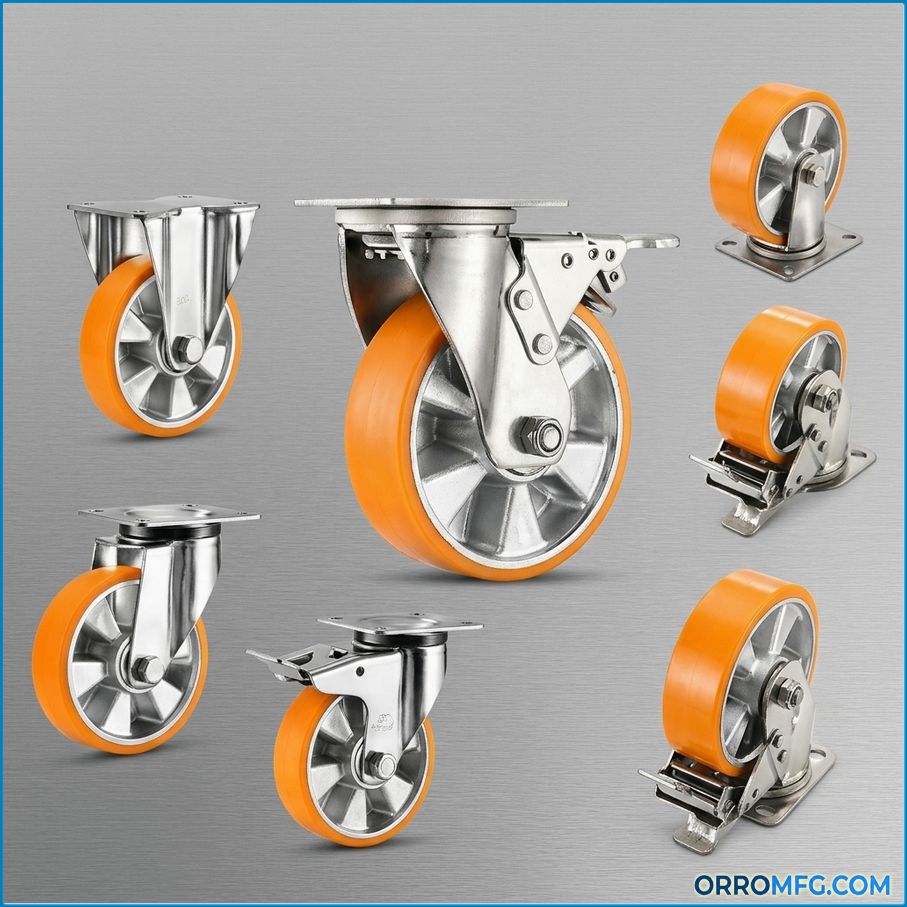
- PU Pallet Truck Wheel — cast iron core wheels for pallet trucks
- PU Guide Wheel — grooved guide rollers for track systems
- PU Roller — conveyor and drive rollers
- Polyurethane material guide — hardness, grades and properties
- Wheels, Rollers & Casters — the full wheel and roller range
Send the wheel diameter, load per caster, mounting type and brake requirement for a same-day quote. A photo of the existing caster with its plate dimensions is usually enough for us to match a replacement.