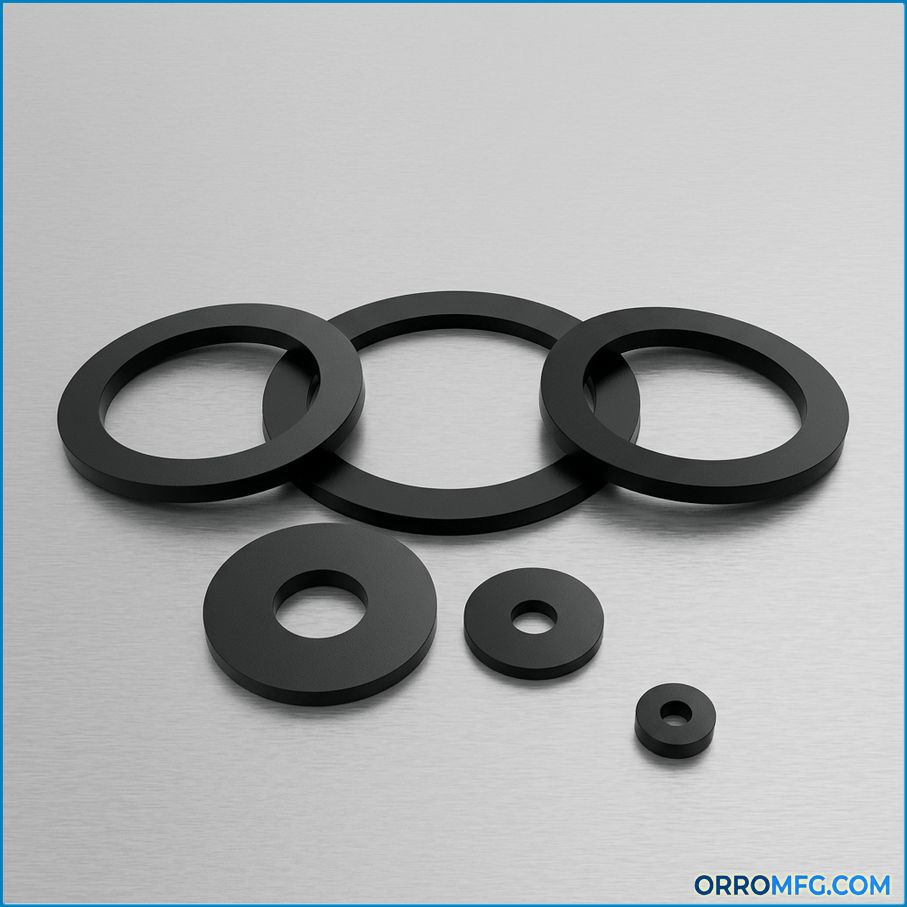
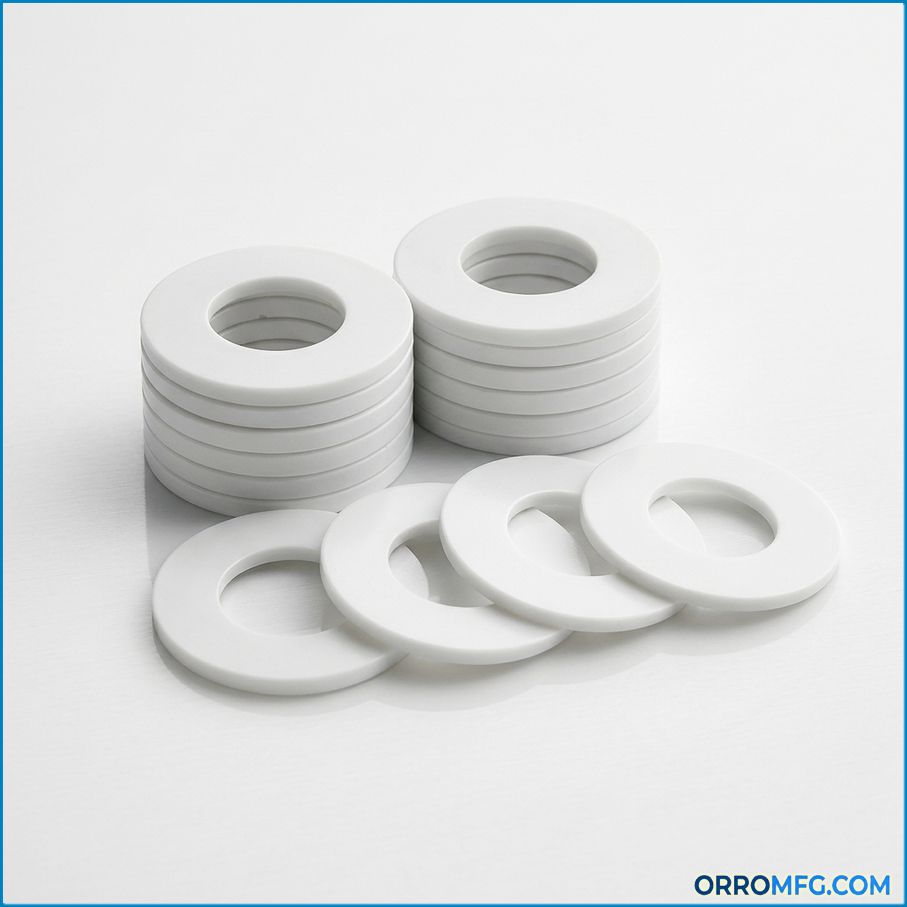
Overview
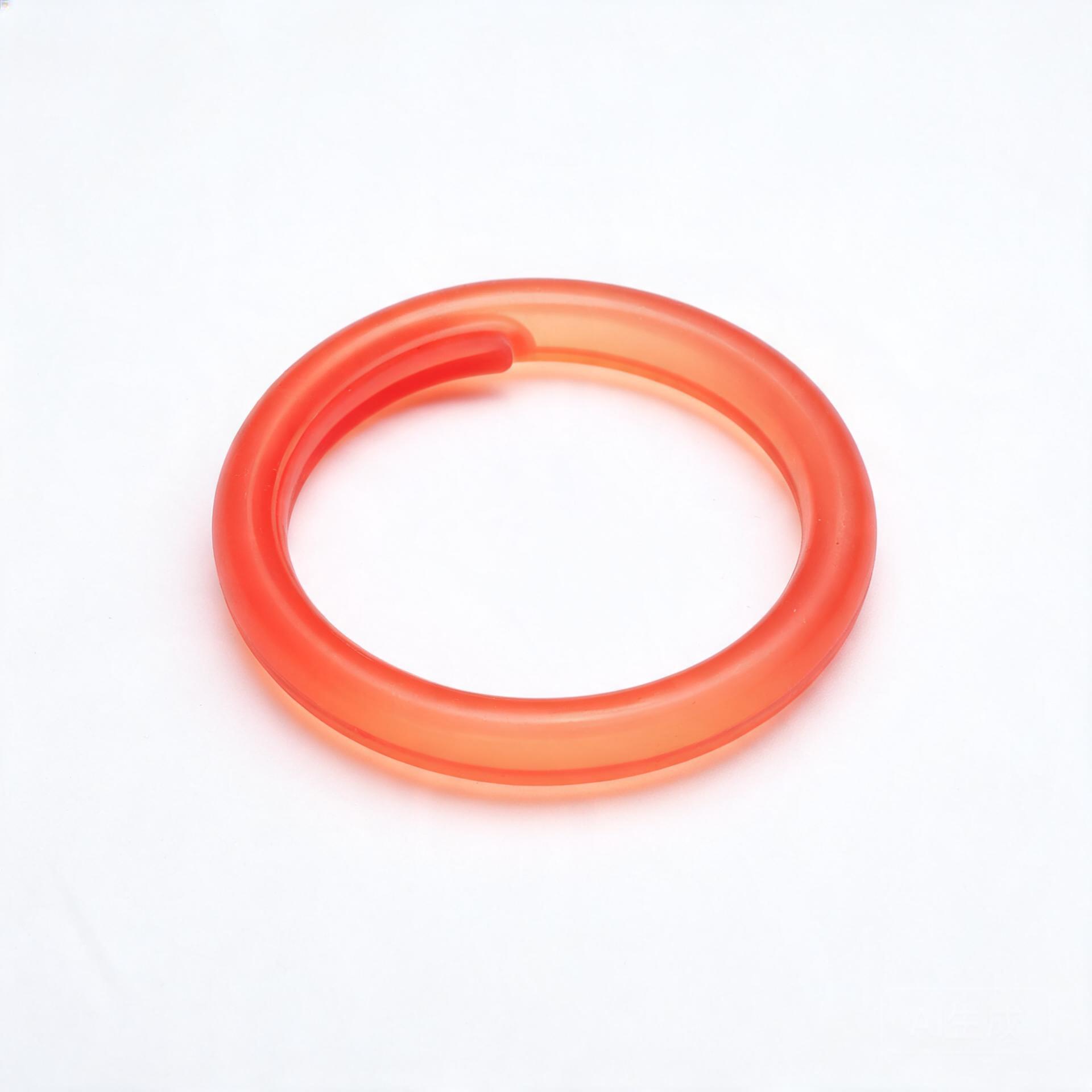
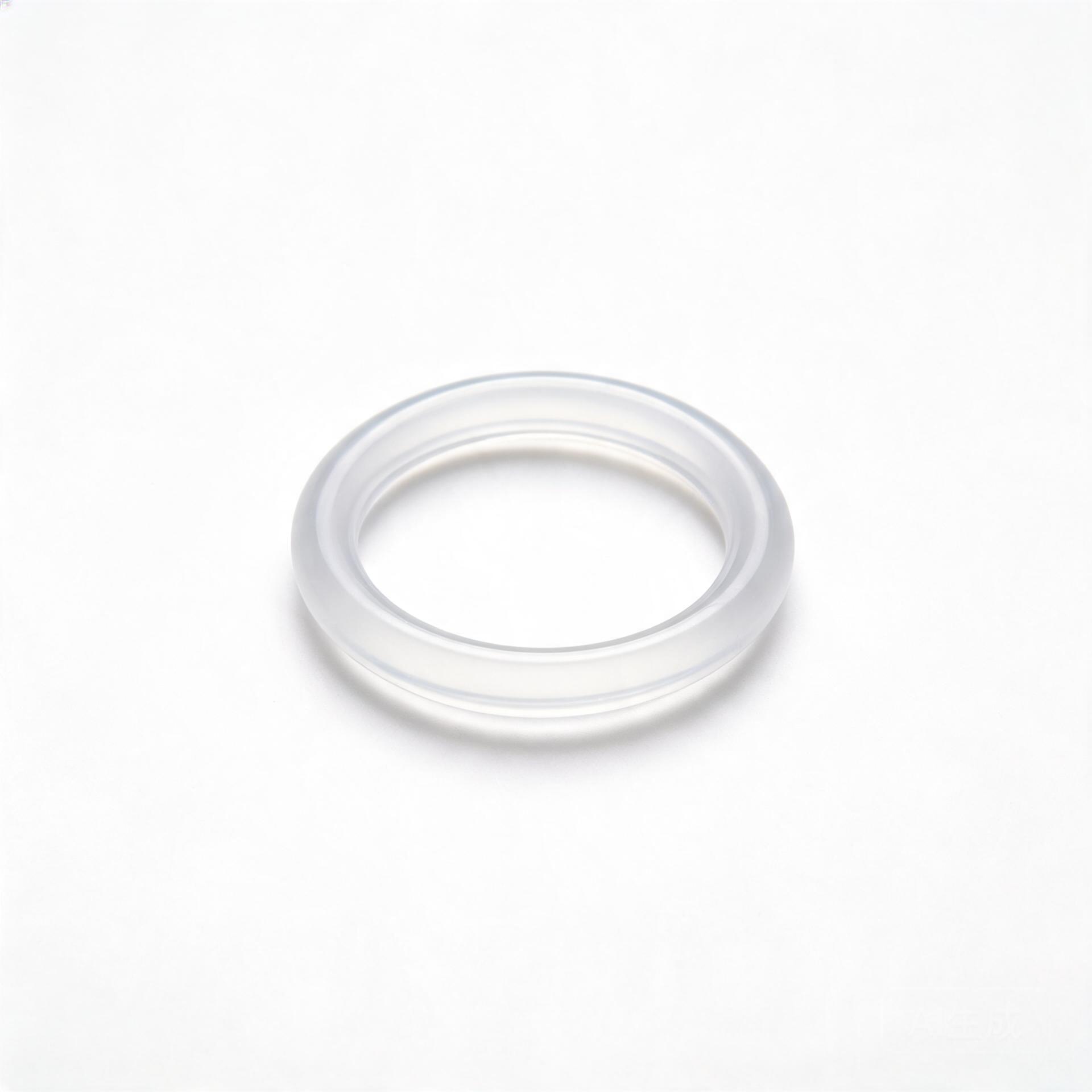
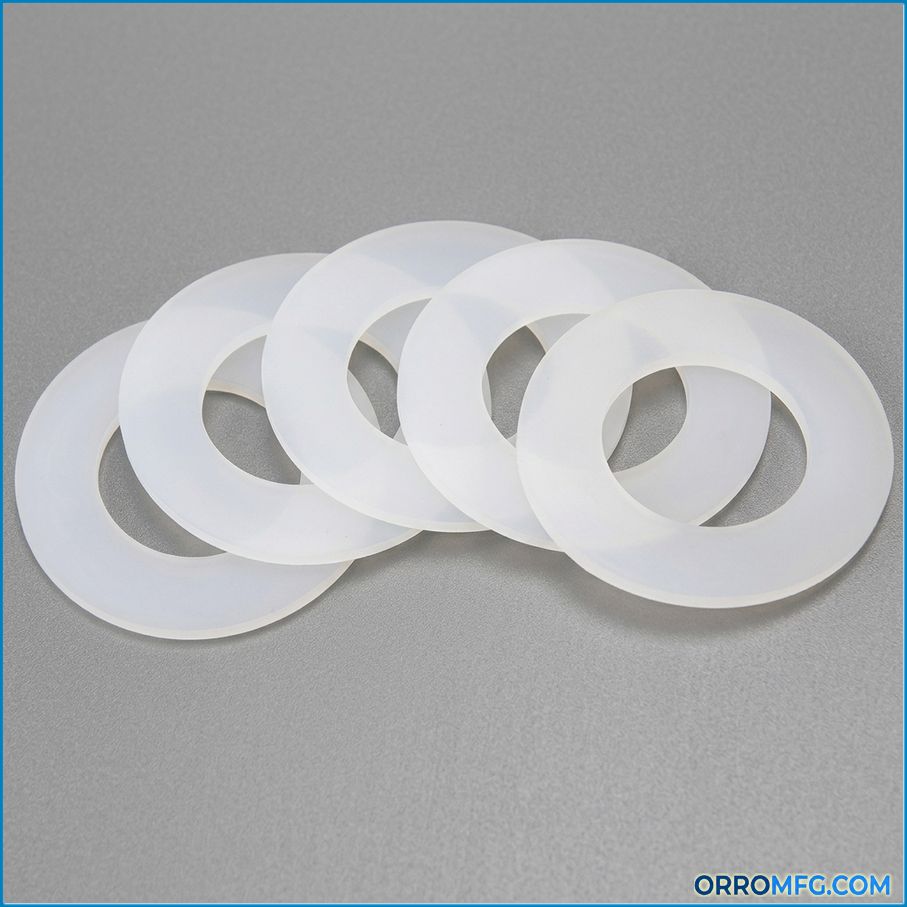
Silicone flat washers and gaskets are translucent or coloured rings made from silicone rubber (VMQ). They are chosen for three properties that no other low-cost elastomer combines: a service range from -60 °C to +230 °C, a clean food-contact surface, and electrical insulation. Where a joint is hot, must be washed down, or sits between a heated surface and a plastic housing, silicone is usually the simplest answer.
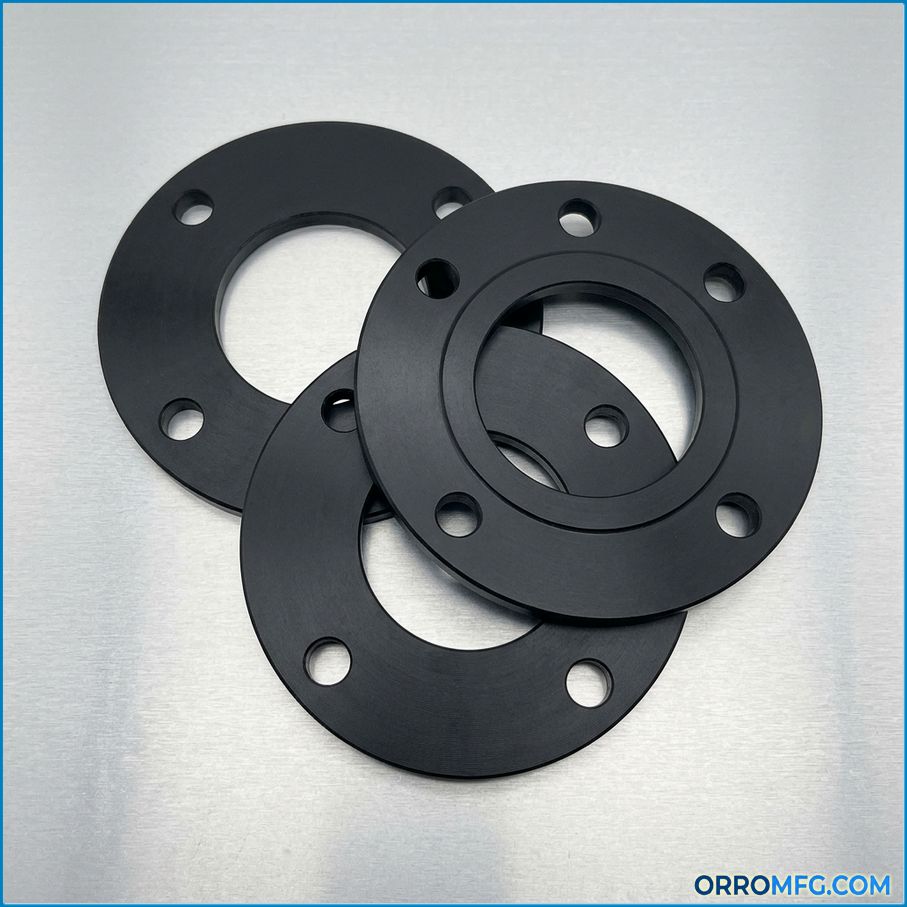
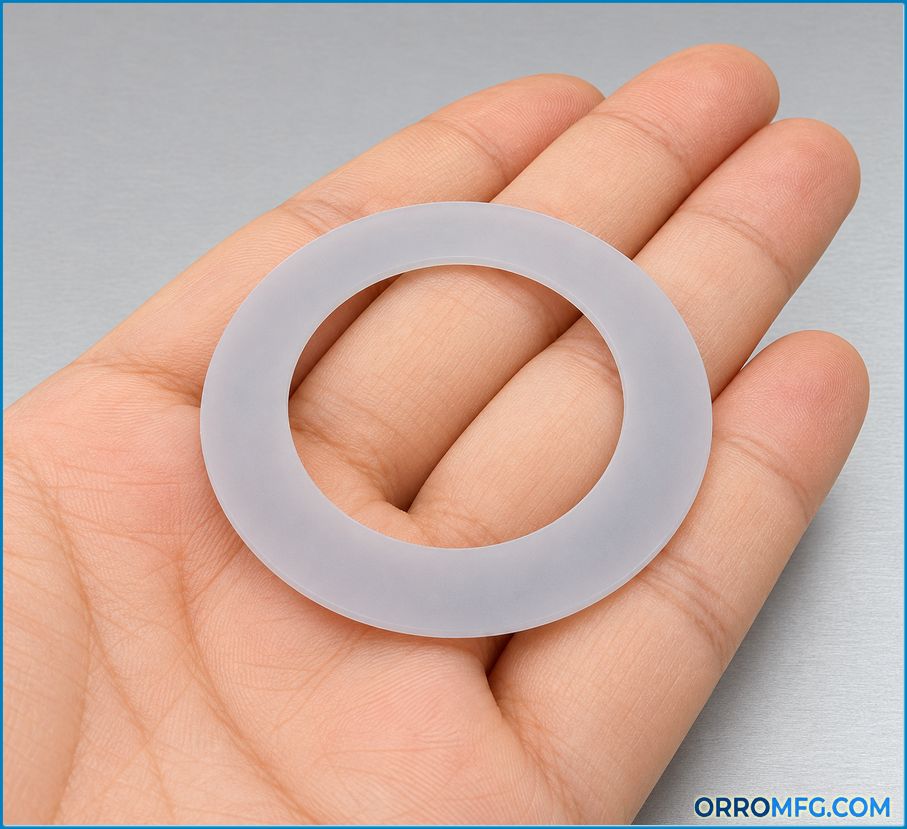
The standard part is a flat ring: 1.5-3 mm thick, 50-70 Shore A, cut or moulded to the bore and outside diameter of the joint. Food-grade compounds are formulated to FDA 21 CFR 177.2600 and can be supplied with compliance declarations, which is what makes these washers common on bottling lines, dairy equipment and dispensing heads. The same ring doubles as a thermal break, an electrical insulator and a vibration damper.
ORRO supplies silicone flat washers from 1 mm to 10 mm thick, in translucent white, black, red, blue and custom colours, die-cut from sheet or compression moulded to your drawing. Because silicone is soft and tears easily, thickness and hardness are chosen together — a thin soft ring will extrude under bolt load, and a thick hard one will not seal a light cover.
Key Features
- Extreme Temperature Range: Flexible from -60 °C to +230 °C — far wider than NBR or EPDM, and enough for oven doors, heater plates and engine-adjacent parts.
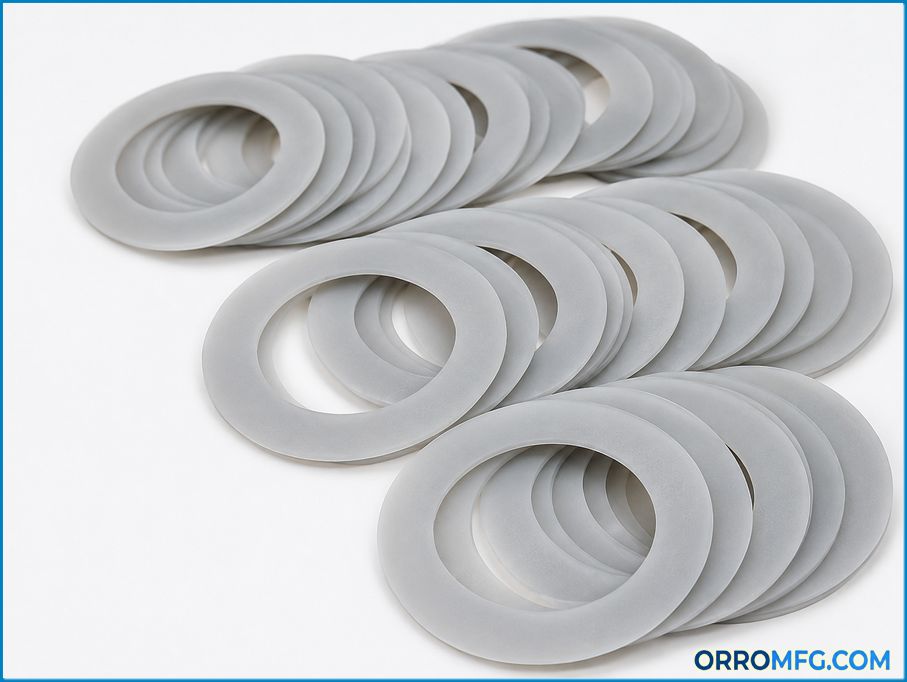
- Food-Contact Compounds: FDA-compliant grades in translucent white, grey and blue, with compliance declarations supplied per batch.
- Weather and Ozone Resistance: No cracking or hardening after years of UV and ozone exposure, unlike nitrile.
- Electrical Insulation: Dielectric strength of 15-25 kV/mm makes the same washer usable as an insulating spacer under a terminal or heatsink.
- Compressible and Conformable: Soft grades conform to slightly uneven faces at low bolt load, sealing without a machined groove.
- Clean Release: Non-stick and non-marking, so the gasket lifts off the face without residue during a washdown or maintenance strip-down.
Material Specifications
| Property | Silicone (VMQ) | Note |
|---|---|---|
| Hardness (Shore A) | 30 - 80 | 50-70 A typical for flat washers |
| Tensile Strength (MPa) | 5 - 10 | Lower than NBR or EPDM |
| Elongation at Break (%) | 200 - 500 | |
| Compression Set (%) | 20 - 40 | Higher than NBR — static seals only |
| Continuous Service Temp (°C) | -60 to +230 | Short excursions to +250 °C |
| Density (g/cm³) | 1.10 - 1.25 | |
| Tear Strength (kN/m) | 8 - 20 | Tears easily — avoid sharp edges |
| Dielectric Strength (kV/mm) | 15 - 25 | |
| Water / Steam Resistance | Fair | Not for continuous hot water |
| Oil / Fuel Resistance | Poor | Swells in mineral oil |
| Weather / Ozone / UV | Excellent | |
| Standard Thickness | 1, 1.5, 2, 3, 5, 6, 8, 10 mm | Custom up to 20 mm |
Sizes and Thickness
| Dimension | Range | Notes |
|---|---|---|
| Bore (inside diameter) | 3 - 250 mm | Sized to the bolt, port or spigot |
| Outside diameter | 8 - 400 mm | Round, square, rectangular or custom |
| Thickness | 1 - 20 mm | 1.5-3 mm standard; 5 mm+ for gap filling |
| Hardness | 30 - 80 Shore A | 50-70 A typical; 40 A for very light covers |
| Tolerance | ±0.2 mm thickness, ±0.5 mm profile | Tighter on request |
| Colour | Translucent white standard; black, red, blue, grey | Colour coding for size or line |
| Finish | Smooth moulded or sheet-cut | Talc-free available for food service |
Silicone is the softest of the common gasket materials, and that has a consequence: under high bolt load a thin ring extrudes into the gap. Where the joint sees pressure, specify a harder 70-80 A compound and keep the thickness close to the gap, rather than reaching for a thicker gasket.
Applications
Food and Beverage Processing
Washers and gaskets on fillers, caps, dispensing heads, mixers, ovens and conveyor contacts. Food-grade silicone tolerates washdown, oven heat and cleaning chemicals, and the translucent colour shows contamination during inspection.
Medical and Laboratory Equipment
Sterilisable seals for instrument housings, diagnostic equipment, centrifuge covers and lab glassware joints. Silicone withstands repeated autoclave cycles far better than EPDM or NBR.
Appliances and Heating Equipment
Oven door seals, heater plate spacers, kettle and coffee-machine gaskets, and thermal breaks between a hot surface and a plastic housing. The -60 to +230 °C range is the reason silicone appears in almost every appliance that heats.
Electronics and Electrical
Insulating washers under terminals, heatsinks and PCB spacers, where dielectric strength and heat resistance are needed in the same part.
Lighting and Outdoor Equipment
Gaskets for lamp housings, sensor windows and outdoor enclosures. Ozone and UV resistance keeps silicone seals serviceable where nitrile would crack within a season.
When Silicone Is the Wrong Choice
Continuous hot water and steam hydrolyse silicone — use EPDM. Mineral oil, diesel and hydraulic fluid swell it — use NBR or FKM. High-pressure joints need a harder material that will not extrude, and dynamic seals need better tear strength than silicone offers.
Operating Conditions
- Temperature: -60 °C to +230 °C continuous; brief excursions to +250 °C. Low-temperature flexibility is the best of any common gasket elastomer.
- Pressure: Low to medium static joints. Silicone has modest tensile and tear strength, so it is not the material for high-pressure flanges or extrusion-prone gaps.
- Media: Water (short contact), detergents, dilute acids and alkalis, food and beverage products, glycol, air, ozone and UV.
- Not for: Continuous hot water or steam, mineral oil, diesel, petrol, hydraulic fluid, ketones and aromatic solvents.
- Flange Faces: Works well on smooth machined faces at modest bolt load; rough faces need a softer, thicker grade.
- Sterilisation: Withstands autoclave, dry heat and chemical sterilisation cycles, which is why medical and food equipment standardises on silicone.
Material Comparison
| Material | Heat Range | Food Contact | Oil Resistance | Water / Steam | Cost | Best For |
|---|---|---|---|---|---|---|
| Silicone (VMQ) | -60 to +230 °C | Excellent | Poor | Fair | Medium | Heat, food contact, electrical insulation |
| EPDM | -50 to +150 °C | Good | Poor | Excellent | Low | Water, steam, outdoor sealing |
| NBR (Nitrile) | -40 to +120 °C | Fair | Excellent | Fair | Low | Oil, fuel and hydraulic joints |
| FKM (Viton) | -20 to +200 °C | Good | Excellent | Good | High | Aggressive chemicals, hot oil |
| PTFE | -200 to +260 °C | Excellent | Excellent | Excellent | Medium-High | Nearly all chemicals, high purity |
| Neoprene (CR) | -40 to +100 °C | Fair | Fair | Good | Low | Refrigerants and general weather seals |
Choose silicone flat washers when:
- The joint runs above 120 °C, or must stay flexible well below freezing
- Food contact, washdown or sterilisation is involved
- Electrical insulation and sealing are needed in the same part
- The bolt load is modest and the faces are machined
- Ozone, UV and weathering rule out nitrile
Customization Options
- Compounds: Standard VMQ, food-grade (FDA-compliant), high-temperature, low-compression-set, and flame-retardant silicone
- Hardness: 30, 40, 50, 60, 70 and 80 Shore A; intermediate values on request
- Thickness: 1-20 mm; 1.5 mm, 2 mm and 3 mm are stock
- Shapes: Round, square, rectangular, oval, multi-hole and irregular profiles cut to drawing
- Colour: Translucent white, black, red, blue, grey and custom colours to a colour code
- Surface: Smooth, talc-free, or with a thin adhesive backing for vertical assembly
- Marking: Size, batch and material marking on request
- Packaging: Bulk bags, labelled kits, or individually bagged parts for clean-room use
Quality Assurance
ORRO manufactures silicone flat washers within an ISO 9001:2015 certified quality management system. Sheet and moulded stock is verified on receipt for thickness, hardness and compound identity, and each production lot is traceable to its material batch. Parts are inspected for bore, outside diameter, thickness uniformity and edge quality, with hardness checked per batch.
Compression set and dielectric data are available from the compound data sheet, and food-contact compliance declarations can be supplied with the order. Dimensional reports accompany production lots, and first article inspection is available for new tools.
Ordering Information
- Send a drawing, a sample, or the bore, outside diameter and thickness you need.
- Tell us the medium, temperature, bolt load and whether food contact or insulation applies.
- We confirm compound, hardness, colour and thickness, then quote against the drawing.
- Stock thicknesses ship quickly; custom profiles and colours are moulded or cut to order.
Frequently Asked Questions
What is the minimum order quantity?
100 pieces per size and colour. Standard thicknesses are cut from stock sheet; custom profiles, colours and food-grade compounds are quoted at the same 100-piece minimum.
Is this washer actually food-grade?
Yes, when specified: the compound is formulated to FDA 21 CFR 177.2600, and a compliance declaration is supplied with the batch. Say that the part is for food contact when you enquire so the correct compound and documentation are quoted.
Can silicone gaskets be autoclaved?
Yes. Silicone withstands repeated autoclave cycles at 121-134 °C far better than EPDM or NBR, which is why medical, laboratory and food equipment standardises on it. Avoid continuous steam exposure between cycles, which slowly hydrolyses the material.
Silicone or EPDM for a hot water joint?
EPDM. Silicone handles higher temperatures but degrades in continuous hot water and steam. Use silicone for dry heat, ovens and food contact, and EPDM for water and steam lines.
Can I use a silicone washer with oil?
No. Mineral oil, diesel, petrol and hydraulic fluid swell silicone substantially. Use NBR for oil at moderate temperature, or FKM where oil and heat combine.
What hardness should I specify?
50-60 Shore A for light covers and low bolt load, 70-80 A where the joint sees pressure or a wider gap. Softer grades seal uneven faces better but extrude sooner; tell us the pressure and gap and we will confirm.
Can the washer be used as an electrical insulator?
Yes. Dielectric strength of 15-25 kV/mm makes silicone a common insulating washer under terminals, heatsinks and PCB spacers, where it also absorbs heat and compression.
What warranty and support do you provide?
12 months against material and dimensional defects under the stated operating conditions, with technical support on compound selection, hardness and food-contact documentation.
Related Products
- Silicone O-Ring — the same compound in a round profile
- Food-Grade Silicone Seal — food and beverage sealing parts
- Silicone Bolt Protection Cap — masking caps for coating and plating
- EPDM Flat Gasket — water and steam flange gaskets
- NBR Flat Gasket — oil-resistant flat washers
- PTFE Gasket — aggressive chemicals and high purity
Send your drawing or the bore and thickness you need for a quote. Tell us the temperature, the medium and whether food contact applies, and we will confirm the compound.